
By : Faith Nkwoukwa , Akachi Nwaogwugwu & Okechukwu D. Okechukwu
Since the early days of aviation, the causes of aircraft accidents have shifted dramatically. In the past, mechanical failures were the dominant factor, but as aircraft design and component reliability have improved, human error has become the leading cause of aviation accidents and incidents. Today, human error accounts for about 90 percent of aviation occurrences, with pilot error responsible for the majority. However, maintenance errors still contribute to roughly one-eighth of all accidents, many of which are serious or fatal.
Maintenance errors have received increased attention following major accidents such as Aloha Airlines Flight 243 (1988) and Alaska Airlines Flight 261 (2000). While airlines have strengthened oversight in response, general aviation (GA) continues to experience a higher rate of maintenance-induced failures, often with less scrutiny and fewer safeguards than commercial operations.
Maintenance errors generally fall into two categories:
- Maintenance-induced failures, where a problem is introduced during maintenance that did not previously exist.
- Failures to detect pre-existing problems during inspections.
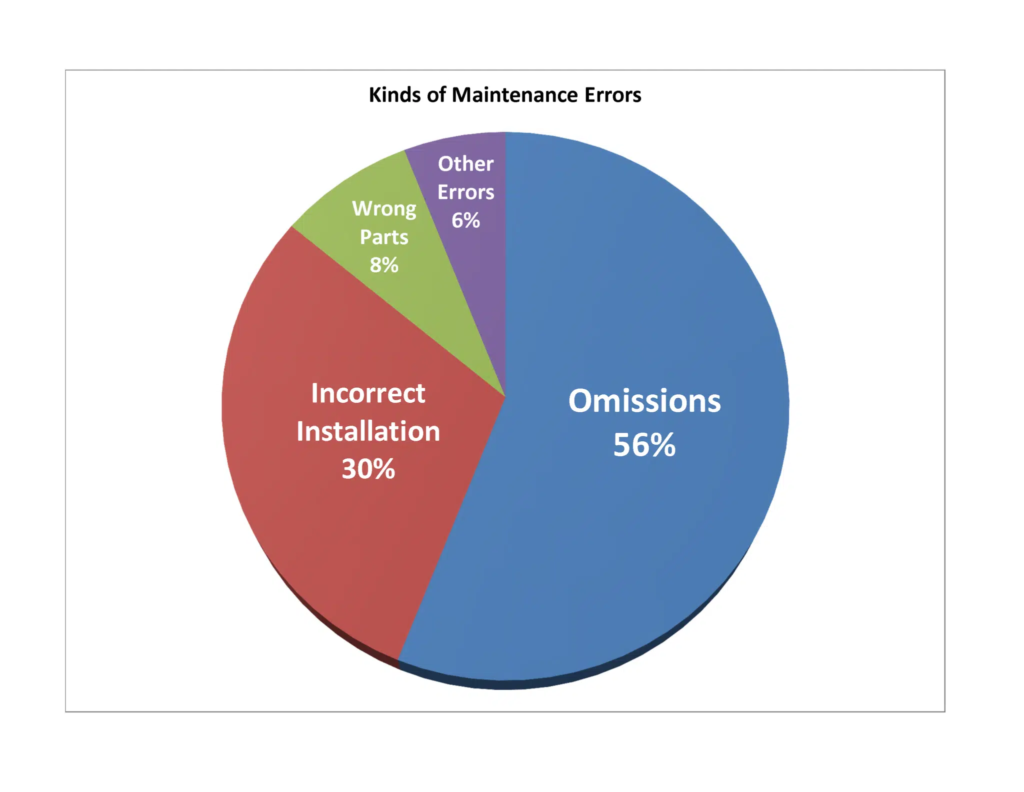
Studies show that the most common maintenance errors are errors of omission, such as failing to install or properly torque fasteners, leaving caps or inspection panels unsecured, or forgetting to reconnect hoses or electrical systems. These errors frequently occur during reassembly, not disassembly. While taking components apart usually follows a clear sequence, reassembly often requires precise knowledge and reference to manuals. Relying on memory instead of written instructions significantly increases the likelihood of mistakes.
Human errors in maintenance can be further classified as slips, mistakes, and violations. Slips occur when technicians intend to do the right thing but forget or perform steps incorrectly. Mistakes result from incorrect plans or lack of knowledge, such as using the wrong torque value. Violations are deliberate deviations from procedures, often involving cutting corners. While slips and mistakes are unintentional, violations can be especially dangerous because they remove safeguards that might otherwise catch errors.
Distractions are a major contributor to maintenance errors. Phone calls, customer interruptions, shift changes, and time pressure can all lead to unfinished tasks and forgotten steps. Smaller maintenance shops, common in general aviation, are particularly vulnerable due to limited staffing and lack of dedicated quality inspectors.
In large manufacturing facilities and major repair stations, safety is improved through multiple layers of inspection, ensuring that more than one person checks each task. In contrast, many GA maintenance activities rely on a single technician, increasing the risk that errors go unnoticed.
Because maintenance errors are most likely to surface on the first flight after maintenance, aircraft owners and pilots play a critical safety role. A meticulous preflight inspection and a cautious post-maintenance test flight in good weather, without passengers, serve as the final line of defense.
Ultimately, while aviation technology continues to advance, human factors remain central to safety. Reducing maintenance-related accidents requires better procedures, fewer distractions, stronger quality assurance, and active involvement from pilots and aircraft owners.