
By: Faith Nkwoukwa , Akachi Nwaogwugwu.
Aviation plays a vital role in Nigeria’s economic development, regional integration, and global connectivity. As Africa’s most populous country and one of its largest economies, Nigeria depends heavily on air transport to link its major cities, facilitate trade, support tourism, and connect the country to international markets. Domestic air travel is especially important due to long distances between cities, poor road infrastructure in some areas, and security concerns that make flying a preferred mode of transport. However, alongside these benefits, aviation in Nigeria also poses significant environmental challenges, particularly in the context of climate change and environmental sustainability.
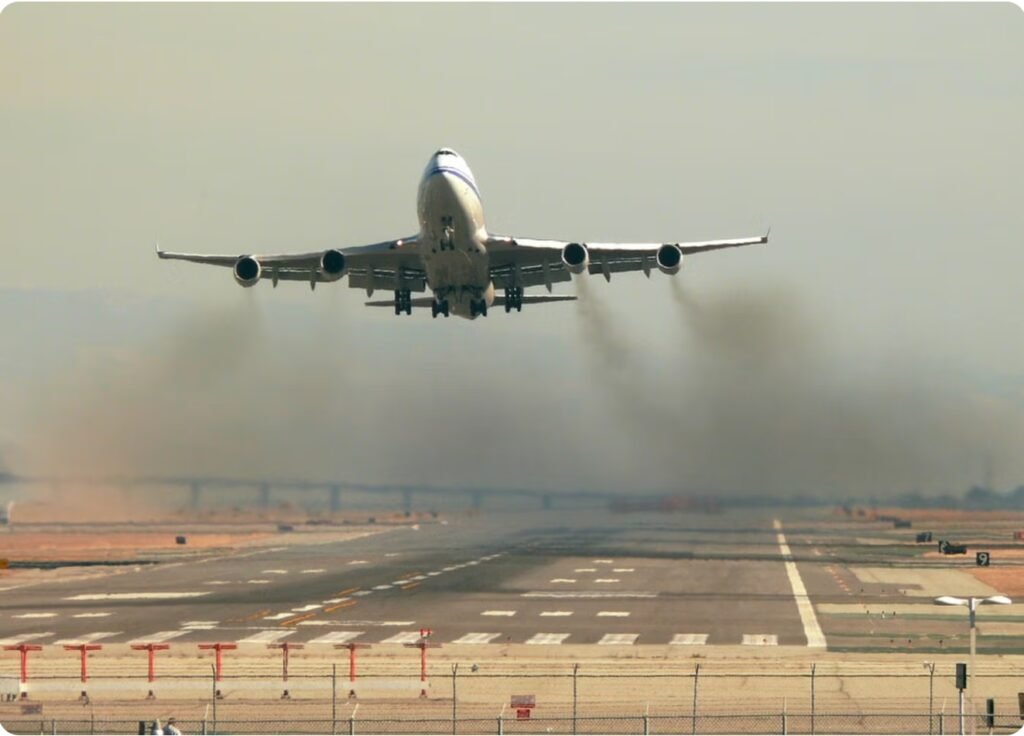
The environmental impact of aviation in Nigeria, as elsewhere, is largely driven by the sector’s dependence on fossil fuels. Aircraft operating within and outside Nigeria rely on aviation turbine kerosene (ATK), a hydrocarbon-based fuel that releases greenhouse gases when burned. These emissions contribute to global warming and climate change, challenges that Nigeria is already experiencing through rising temperatures, desertification in the north, increased flooding in coastal and riverine areas, and more frequent extreme weather events. Although Nigeria’s aviation sector contributes a smaller share of global aviation emissions compared to major aviation hubs in Europe or North America, its impact is still significant at the national and regional level.
Globally, aviation is estimated to be responsible for about 4 percent of human-induced climate change. Nigeria’s share of this figure reflects the steady growth of air travel within the country and across West Africa. Major airports such as Murtala Muhammed International Airport in Lagos, Nnamdi Azikiwe International Airport in Abuja, and Port Harcourt International Airport handle millions of passengers annually. As passenger demand continues to grow, so too does fuel consumption and associated emissions, unless deliberate mitigation measures are put in place.
A key concern with aviation emissions is their release at high altitudes. While some emissions occur during taxiing, takeoff, and landing near airports, the majority are released during cruising at several thousand feet above ground. Emissions at these altitudes can have a stronger warming effect because they interact with atmospheric processes in ways that intensify heat retention. In Nigeria, where climate vulnerability is already high, the cumulative effect of such emissions contributes indirectly to environmental stress across ecosystems and communities.
Aircraft emissions are composed primarily of carbon dioxide, which accounts for roughly 70 percent of exhaust gases and is the main driver of aviation-related climate change. Carbon dioxide remains in the atmosphere for decades, allowing it to accumulate and increase global temperatures over time. Aircraft exhaust also contains water vapor and small amounts of other pollutants, including nitrogen oxides and particulates, which can affect air quality around airports. In densely populated areas such as Lagos, these emissions raise concerns about local air pollution and public health, especially for communities living near airport facilities.
The environmental footprint of aviation in Nigeria extends beyond aircraft emissions alone. Airports require extensive infrastructure, including runways, terminals, control towers, fuel depots, and maintenance facilities. The construction and expansion of airports involve significant land use changes, energy consumption, and material extraction. In some cases, airport development has contributed to the loss of green spaces and increased pressure on surrounding ecosystems. Additionally, airport operations depend on ground support equipment, generators, and vehicles, many of which run on diesel or petrol, further increasing emissions.
Passenger and cargo transport to and from airports also adds to aviation-related pollution. In major Nigerian cities, road congestion around airports leads to increased fuel consumption and emissions from cars, buses, and trucks. This indirect pollution is an often-overlooked component of the aviation sector’s overall environmental impact.
As awareness of climate change grows in Nigeria, public discourse around environmental responsibility is gradually increasing. While the concept of “flight shaming” is less prominent in Nigeria than in parts of Europe, there is rising concern among civil society groups, environmental advocates, and young people about the carbon footprint of aviation and other high-emission sectors. These concerns are often linked to broader issues of environmental justice, as the impacts of climate change in Nigeria disproportionately affect vulnerable communities, including farmers, coastal populations, women, and low-income households.
At the policy level, Nigeria has made international commitments that are relevant to aviation emissions. As a signatory to the Paris Agreement, Nigeria has pledged to reduce its greenhouse gas emissions through its Nationally Determined Contributions (NDCs). While aviation is not always addressed explicitly in national climate discussions, it falls under the broader transport sector, which is recognized as a growing source of emissions. Nigeria is also a member of the International Civil Aviation Organization (ICAO) and has endorsed global goals to achieve net-zero aviation-related carbon dioxide emissions by 2050.
Meeting these commitments presents both challenges and opportunities for Nigeria. One major challenge is the age and efficiency of aircraft operating within the country. Many domestic airlines operate older aircraft models that are less fuel-efficient than newer designs. Improving fleet efficiency through aircraft modernization could significantly reduce fuel consumption and emissions, but this requires substantial financial investment, which can be difficult in a sector already facing high operating costs.
Another potential pathway for reducing aviation’s environmental impact in Nigeria is the adoption of sustainable aviation fuels (SAFs). Nigeria has strong potential in this area due to its agricultural resources and emerging interest in bioenergy. If developed responsibly, SAFs could reduce lifecycle emissions from aviation while creating new economic opportunities. However, careful planning is required to ensure that biofuel production does not compete with food security or lead to environmental degradation.
In the absence of widespread technological transformation, many airlines globally, including those operating in Nigeria, have turned to carbon offsetting as an interim measure. This may involve supporting tree-planting initiatives, renewable energy projects, or environmental conservation programs. While such measures can help balance emissions, they are not a substitute for long-term structural changes in fuel use and aircraft technology.
Looking ahead, the future of aviation in Nigeria will depend on balancing economic growth with environmental sustainability. Aviation is essential for national development, regional integration, and Nigeria’s role in the global economy. At the same time, unchecked growth in emissions could undermine the country’s climate goals and worsen environmental vulnerabilities.
In conclusion, aviation is both a critical asset and an environmental challenge for Nigeria. Its reliance on fossil fuels contributes to greenhouse gas emissions that exacerbate climate change, a problem Nigeria is already struggling to manage. Addressing the environmental impact of aviation will require coordinated efforts involving government agencies, airlines, regulators, and civil society. Through improved efficiency, policy alignment, sustainable fuels, and responsible planning, Nigeria has the opportunity to develop an aviation sector that supports connectivity and economic growth while minimizing harm to the environment and future generations.